
Industrial renovations rarely happen in an empty building with nothing else going on. Equipment may need to stay in place, production areas may not be disturbed for long, utilities may need to be worked around, and several trades may be trying to complete their part of the project in the right order.
Concrete is often somewhere in the middle of those plans. A concrete cutting service may be needed to open a floor for new utilities, modify a wall for equipment access, create a new doorway, or remove a specific section of existing concrete. The actual cutting may happen quickly. Getting to that point takes a little more thought.
Existing Buildings Come With Existing Conditions
Renovating an industrial building is different from working with a blank slab.
Years of additions, equipment changes, utility work, and previous renovations can leave plenty behind the concrete that is not obvious from the surface. Even when drawings are available, you still need to consider field conditions.
Before cutting begins, useful questions include:
- What needs to pass through the new opening?
- How thick is the concrete?
- Is the wall or slab reinforced?
- What utilities may be nearby?
- How much room is available for cutting equipment?
- What happens in the area immediately after the cut is complete?
- Does the surrounding facility need to remain operational?
Those answers can help determine both the cutting method and how to sequence the work. For projects where embedded objects are a concern, concrete scanning may also be useful before a planned cut or penetration is made.
Not Every Industrial Cut Calls for the Same Saw
“Cut the concrete” sounds simple until you look at where the concrete is and what needs to be removed.
A floor opening for new process piping is a different job from adding a doorway through a reinforced concrete wall. A thick foundation or large concrete structure may call for another method entirely.
That is why a concrete cutting service can involve several different types of equipment.
For example, flat sawing is commonly used on horizontal surfaces such as concrete floors and slabs. During an industrial renovation, that may include cutting areas for utility trenches, equipment foundations, or sections of flooring scheduled for removal.
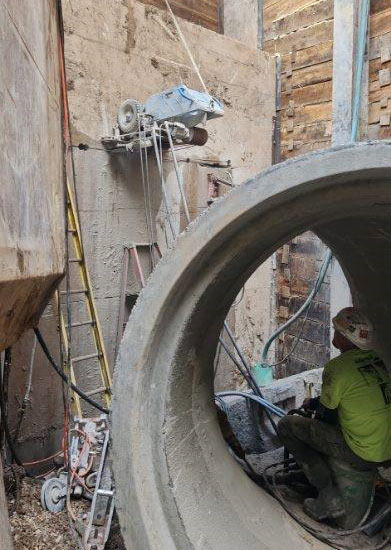
When the work involves a vertical concrete wall, wall sawing allows straight, controlled openings to be created for doors, mechanical access, equipment changes, and other modifications.
Then there are the jobs where access, thickness, reinforcement, or the size of the concrete changes the equation. Con-Cor also uses methods such as hand sawing, chain sawing, core drilling, and wire sawing when the project conditions call for them. The goal is not to force every renovation into the same cutting method. It is to look at what needs to change and choose the equipment that makes sense for that particular area.
Good Cutting Should Make the Next Step Easier
Concrete cutting is rarely the final step of an industrial renovation. Someone usually needs the opening afterward. A plumbing crew may be waiting to install a new line. Electricians may need access for conduit. Mechanical equipment may have to move through a new wall opening. Another portion of the slab may need to stay untouched because existing equipment is staying exactly where it is.
That is why layout and coordination matter so much. A cut that matches the plans, dimensions, and needs of the next trade helps the project continue forward. A cut made without considering what happens next can create another problem for someone else to solve.
For facilities preparing for this type of work, Con-Cor’s guide to worksite preparation covers several of the conditions worth thinking through before sawing or drilling begins.
Industrial Renovations Usually Reward Planning Ahead
Existing facilities often reveal something unexpected once work starts. Not every condition can be predicted, but concrete cutting should not add unnecessary guesswork. Knowing the required opening, site access, concrete conditions, nearby utilities, and what needs to happen after the cut gives the cutting crew much more useful information than simply marking an X on the floor.
Con-Cor has worked on concrete sawing and drilling projects across industrial, commercial, and infrastructure settings throughout Wisconsin and the Midwest. If an upcoming renovation requires a concrete cutting service, sharing plans, dimensions, site conditions, and project sequencing ahead of time can help determine the right way to approach the work.
Contact Con-Cor to discuss the concrete modifications involved in your upcoming project.