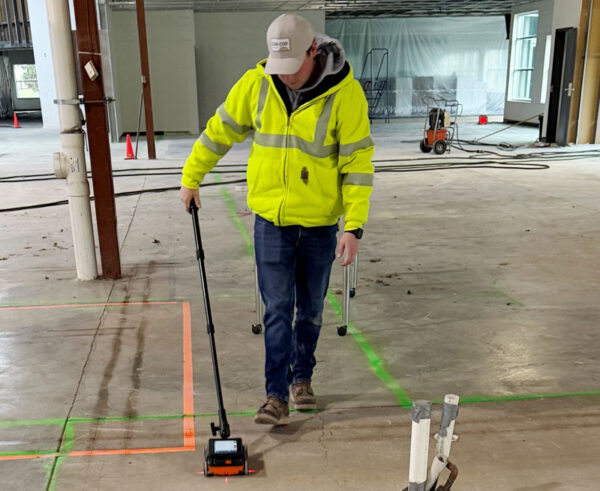

Before a saw blade, drill bit, or anchor reaches an existing slab, someone needs to know what is inside it. GPR concrete scanning may be required by project specifications, the property owner, the general contractor’s safety plan, or a facility’s work-permit process. Even when no rule specifically calls for ground penetrating radar, a scan may still be necessary to identify concealed hazards before concrete is disturbed.
The short answer is that scanning should be completed whenever a cut, core, or drilled hole could contact reinforcement, electrical conduit, post-tension cables, plumbing, or another embedded object. Drawings are a useful starting point, but they do not always match current field conditions.
When Is GPR Concrete Scanning Required?
There is no single nationwide rule stating that every concrete cut must first be scanned with radar. Requirements usually come from the project documents, the facility owner, the engineer, the general contractor, or the conditions found on site.
OSHA does not name GPR as the only acceptable method. However, employers are responsible for addressing electrical hazards that workers could contact during their work. OSHA training materials also call for concealed electrical conductors to be identified and marked before drilling or cutting into walls, ceilings, or floors. In many existing buildings, radar is one of the most practical tools available for doing that.
A scan will commonly be required when:
- The project specifications call for concrete scanning before cutting
- An owner or general contractor has a mandatory scan-before-you-cut policy
- A hospital, school, manufacturing plant, or other active facility requires a penetration permit
- The structural engineer needs reinforcement mapped before approving an opening
- The slab contains, or may contain, post-tension cables
- Existing drawings are incomplete, outdated, or unavailable
- Cutting could interfere with active building systems
The requirement may appear in the plans, a site-specific safety manual, a contractor orientation packet, or a permit form rather than in a building code.
Post-Tensioned and Structurally Reinforced Concrete
Post-tensioned slabs deserve particular attention. Their steel tendons are placed under considerable force and are part of the structural system. Accidentally cutting one is not the same as nicking an unused sleeve or abandoned pipe.
Post-tension cable detection allows the proposed opening to be reviewed against the locations of tendons and other reinforcement. An engineer may still need to approve the final cut, particularly when the opening affects a suspended slab, parking deck, transfer slab, or other structural member.
Radar can also support locating rebar in concrete before wall sawing, floor sawing, or drilling. A project does not always need to avoid every reinforcing bar. In some cases, the engineer may permit certain bars to be cut. The important point is that those decisions should be made deliberately, not discovered when the blade reaches the steel. Con-Cor’s scanning service locates and marks reinforcement, post-tension cables, conduit, and other embedded obstructions before work begins.
Cutting Near Electrical and Mechanical Systems
Embedded conduit can be difficult to predict from the surface. A floor may look clear even though power, controls, communications wiring, radiant heat, or process-related systems run through the slab.
That makes embedded utility locating especially important in occupied or operating buildings. A conduit strike can shut down more than the immediate work area. Depending on the building, it could interrupt production equipment, alarms, data systems, lighting, refrigeration, medical equipment, or other critical operations.
The same issue comes up with plumbing and mechanical work. A floor trench for new sanitary piping may cross existing sleeves or lines. A core hole for an HVAC, electrical, or fire-protection penetration may land directly over an embedded obstruction. Radar gives the cutting crew better information before the first hole is drilled. OSHA identifies drilling and cutting into floors, walls, and ceilings as tasks that may expose workers to concealed live conductors.
Real-World Projects Where Scanning May Be Necessary
The need for concrete slab scanning goes well beyond a few common examples. It frequently comes up during renovation and retrofit work, including:
- Cutting a new plumbing trench through a grocery store, restaurant, or food-production floor
- Drilling equipment anchors in a manufacturing plant with embedded power and controls
- Creating openings for new medical gas, plumbing, or electrical lines in a hospital
- Installing vehicle barriers or security bollards near building entrances
- Adding server racks, cable pathways, or cooling systems inside a data center
- Cutting stair, elevator, or material-handling openings through elevated floors
- Drilling through a parking structure for drainage, lighting, or communication systems
- Installing rooftop equipment where penetrations pass through a structural deck
- Modifying laboratories that contain specialized utilities or process lines
- Anchoring shelving, lifts, conveyors, racking, or guardrails into an existing slab
- Saw cutting around pits, foundations, or machine bases inside industrial facilities
- Creating new door and window openings through reinforced concrete walls
These projects do not all carry the same level of risk. A shallow fastener is different from a full-depth core. A slab-on-grade behaves differently from an elevated post-tensioned floor. The scan should match the actual depth, location, and purpose of the planned work.
Why Drawings Are Not Always Enough
As-built drawings can narrow the search area, but they should not automatically be treated as a picture of current conditions. Field changes may not have been recorded. Renovations may have added new systems. Conduit may shift during placement, and reinforcement may not sit exactly where the drawing suggests.
That is why GPR scanning before core drilling is often used as field verification rather than as a replacement for plans. The technician scans the work area, reviews the signals, and marks relevant findings on the concrete. The cutting or drilling location can then be evaluated against what was found. Con-Cor also keeps its scanning, field communication, and cutting coordination in-house, which can reduce back-and-forth when a proposed opening needs to move.
Does Every Concrete Cut Need to Be Scanned?
Not necessarily. A project may involve newly placed concrete with thoroughly documented conditions, no embedded systems, and clear approval from the responsible parties. Shallow decorative cutting may also present a different situation than full-depth sawing or coring.
However, uncertainty should not be treated as proof that the slab is clear. When the crew cannot confidently account for what lies within the concrete, scanning provides useful information before the work becomes permanent. The decision should consider the structure, cut depth, building use, available drawings, nearby systems, project specifications, and the consequences of an unexpected strike.
Plan the Scan Before the Cutting Crew Arrives
Scanning works best when it is part of pre-task planning rather than a last-minute response. The technician should know the approximate opening size, required depth, work area, and reason for the penetration. Plans are helpful when available, but the scan provides a current view of conditions in the field.
For contractors working in Wisconsin and the Midwest, GPR concrete scanning can help identify conflicts before concrete cutting, core drilling, anchoring, or structural modifications begin. Contact Con-Cor to discuss the proposed work area, penetration details, and scanning needs for your upcoming project.